
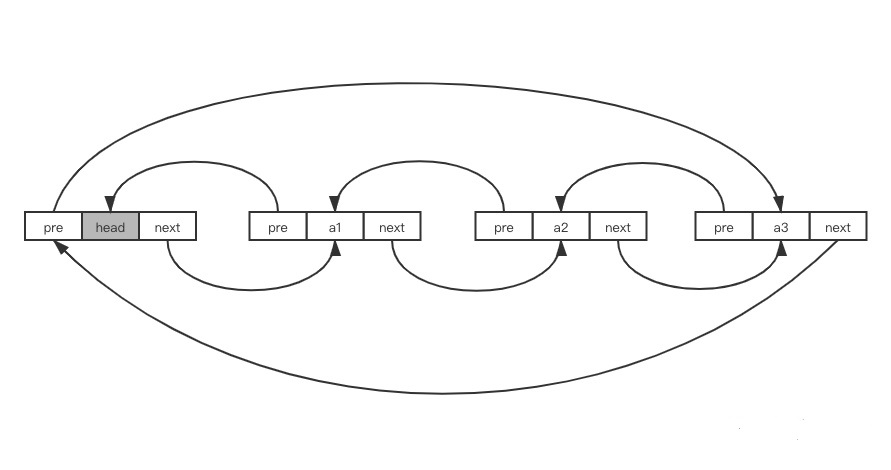
什么是ring
ring是一个环形链表,结构体如下:
type Ring struct {
	next, prev *Ring
	Value      interface{} // for use by client; untouched by this library
}
go的ring实现
初始化
func (r *Ring) init() *Ring {
	r.next = r // 指向了自身
	r.prev = r
	return r
}
接下来是基本操作,重点地方带有注释
// Next returns the next ring element. r must not be empty.
func (r *Ring) Next() *Ring {
	if r.next == nil {
		return r.init()
	}
	return r.next
}

// Prev returns the previous ring element. r must not be empty.
func (r *Ring) Prev() *Ring {
	if r.next == nil {
		return r.init()
	}
	return r.prev
}

// Move moves n % r.Len() elements backward (n < 0) or forward (n >= 0)
// in the ring and returns that ring element. r must not be empty.
//
func (r *Ring) Move(n int) *Ring {
	if r.next == nil {
		return r.init()
	}
	switch {
	case n < 0:
		for ; n < 0; n++ {
			r = r.prev
		}
	case n > 0:
		for ; n > 0; n-- {
			r = r.next
		}
	}
	return r
}

// New creates a ring of n elements.
func New(n int) *Ring { // 新建的时候默认value都是nil
	if n <= 0 {
		return nil
	}
	r := new(Ring)
	p := r
	for i := 1; i < n; i++ { // 0 是第一个
		p.next = &Ring{prev: p}
		p = p.next
	}
	p.next = r
	r.prev = p
	return r
}

// Link connects ring r with ring s such that r.Next()
// becomes s and returns the original value for r.Next().
// r must not be empty.
//
// If r and s point to the same ring, linking
// them removes the elements between r and s from the ring.
// The removed elements form a subring and the result is a
// reference to that subring (if no elements were removed,
// the result is still the original value for r.Next(),
// and not nil).
//
// If r and s point to different rings, linking
// them creates a single ring with the elements of s inserted
// after r. The result points to the element following the
// last element of s after insertion.
//
func (r *Ring) Link(s *Ring) *Ring { // 把两个环链接起来
	n := r.Next()
	if s != nil {
		p := s.Prev() // 如果单个,就是指向本身
		// Note: Cannot use multiple assignment because
		// evaluation order of LHS is not specified.
		r.next = s
		s.prev = r
		n.prev = p // 链接到中间
		p.next = n
	}
	return n
}

// Unlink removes n % r.Len() elements from the ring r, starting
// at r.Next(). If n % r.Len() == 0, r remains unchanged.
// The result is the removed subRing. r must not be empty.
//
func (r *Ring) Unlink(n int) *Ring {
	if n <= 0 {
		return nil
	}
	return r.Link(r.Move(n + 1))
}

// Len computes the number of elements in ring r.
// It executes in time proportional to the number of elements.
//
func (r *Ring) Len() int {
	n := 0
	if r != nil {
		n = 1
		for p := r.Next(); p != r; p = p.next {
			n++
		}
	}
	return n
}

// Do calls function f on each element of the ring, in forward order.
// The behavior of Do is undefined if f changes *r.
func (r *Ring) Do(f func(interface{})) {
	if r != nil {
		f(r.Value)
		for p := r.Next(); p != r; p = p.next {
			f(p.Value)
		}
	}
}
总结
go的ring代码不好理解,涉及到指针的操作,可以在理解环的基础上直接使用
下面是最常用的int型用例
func ExampleRing_Len() {
	// Create a new ring of size 4
	r := ring.New(4)

	// Print out its length
	fmt.Println(r.Len())

	// Output:
	// 4
}

func ExampleRing_Next() {
	// Create a new ring of size 5
	r := ring.New(5)

	// Get the length of the ring
	n := r.Len()

	// Initialize the ring with some integer values
	for i := 0; i < n; i++ {
		r.Value = i
		r = r.Next()
	}

	// Iterate through the ring and print its contents
	for j := 0; j < n; j++ {
		fmt.Println(r.Value)
		r = r.Next()
	}

	// Output:
	// 0
	// 1
	// 2
	// 3
	// 4
}

func ExampleRing_Prev() {
	// Create a new ring of size 5
	r := ring.New(5)

	// Get the length of the ring
	n := r.Len()

	// Initialize the ring with some integer values
	for i := 0; i < n; i++ {
		r.Value = i
		r = r.Next()
	}

	// Iterate through the ring backwards and print its contents
	for j := 0; j < n; j++ {
		r = r.Prev()
		fmt.Println(r.Value)
	}

	// Output:
	// 4
	// 3
	// 2
	// 1
	// 0
}

func ExampleRing_Do() {
	// Create a new ring of size 5
	r := ring.New(5)

	// Get the length of the ring
	n := r.Len()

	// Initialize the ring with some integer values
	for i := 0; i < n; i++ {
		r.Value = i
		r = r.Next()
	}

	// Iterate through the ring and print its contents
	r.Do(func(p interface{}) {
		fmt.Println(p.(int))
	})

	// Output:
	// 0
	// 1
	// 2
	// 3
	// 4
}

func ExampleRing_Move() {
	// Create a new ring of size 5
	r := ring.New(6)

	// Get the length of the ring
	n := r.Len()

	// Initialize the ring with some integer values
	for i := 0; i < n; i++ {
		r.Value = i
		r = r.Next()
	}

	// Move the pointer forward by three steps
	r = r.Move(3) // 把头指针移到第三位

	// Iterate through the ring and print its contents
	r.Do(func(p interface{}) {
		fmt.Println(p.(int))
	})

	// Output:
	// 3
	// 4
	// 5
	// 0
	// 1
	// 2
}

func ExampleRing_Link() {
	// Create two rings, r and s, of size 2
	r := ring.New(2)
	s := ring.New(2)

	// Get the length of the ring
	lr := r.Len()
	ls := s.Len()

	// Initialize r with 0s
	for i := 0; i < lr; i++ {
		r.Value = 0
		r = r.Next()
	}

	// Initialize s with 1s
	for j := 0; j < ls; j++ {
		s.Value = 1
		s = s.Next()
	}

	// Link ring r and ring s
	rs := r.Link(s)

	// Iterate through the combined ring and print its contents
	rs.Do(func(p interface{}) {
		fmt.Println(p.(int))
	})

	// Output:
	// 0
	// 0
	// 1
	// 1
}

func ExampleRing_Unlink() {
	// Create a new ring of size 6
	r := ring.New(6)

	// Get the length of the ring
	n := r.Len()

	// Initialize the ring with some integer values
	for i := 0; i < n; i++ {
		r.Value = i
		r = r.Next()
	}
	r.Do(func(p interface{}) {
		fmt.Println(p.(int))
	})

	// Unlink three elements from r, starting from r.Next()
	r.Unlink(3)

	// Iterate through the remaining ring and print its contents
	r.Do(func(p interface{}) {
		fmt.Println(p.(int))
	})

	// Output:
	// 0
	// 4
	// 5
}